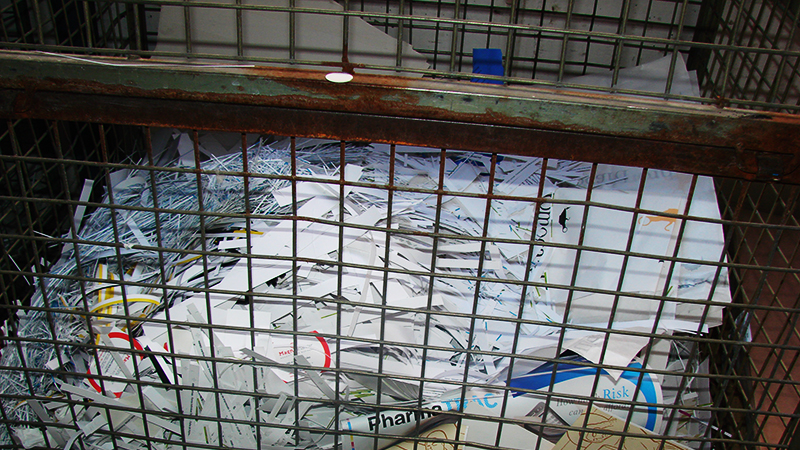
Wastepaper container for collection

Like any industrial company, Lobão Typography has to worry about preserving the environment and minimizing the possible negative impact of its activities.
Offset printing activity produces moderately toxic waste resulting from used paint, thinner, machine wash and lubrication, plus some other waste in small quantities.
Those residues, according to law and common sense, must not be discharged into the sewer. We keep them until deposition, which is carried on by a specialized company that visits us regularly with an adequate vehicle.
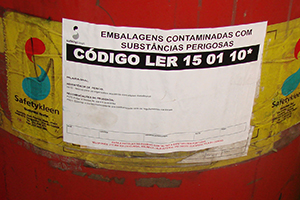
Container for chemical residue, properly labeled, waiting for collection
Other commercially recycled residues are the metallic printing plates. What has value is the plate aluminum and the silver from the photographic film. The development baths used in plate production have value too, due to the silver.
As to the digital printing, every residue is in the form of used packages of diverse kinds of consumables, from the several printers we use. Due to our intensive work, the quantity of boxes of used consumables is sometimes surprising. They are collected by a a specialized recycling service.
Paper
Graphic activity is a natural producer of much paper waste. It is in our interest to limit the quantity of waste, because we have to pay the paper dearly to our providers. So, we try to print the maximum part of every sheet, but there are always some small strips at the limits that must be cut with the guillotine, just for the work to be finalized.
Those strips, which we in the art use to call paper chips, along with the sheets used to proofing, are gathered in big metallic containers to be collected by a paper recycling company. That company pays a modest sum for our paper waste, but the service it renders taking away the paper is far more important.
Energy
Our biggest use of energy is in the driving force to move the offset printers, the several binding and collating machines, the guillotines, the big digital printers. Next comes the air conditioning, as much what is needed for staff comfort as what is required for the operation of the more sensible electronics, like the computers and the digital printers.
Unfortunately, we have been unable to put air conditioning in the bigger spaces, due to the forbidding price, and that has demanded a big sacrifice to some of our collaborators. But our building has a large roof and we are studying the possibility of creating a system of solar panels to provide, in the whole or partially, for our energy needs.
The crisis has not allowed us to make this investment, besides the prices of equipment being unbearable. However, they have been coming down slowly but steeply. We trust that, should there be an economic recovery, we will soon be able to make this option.